
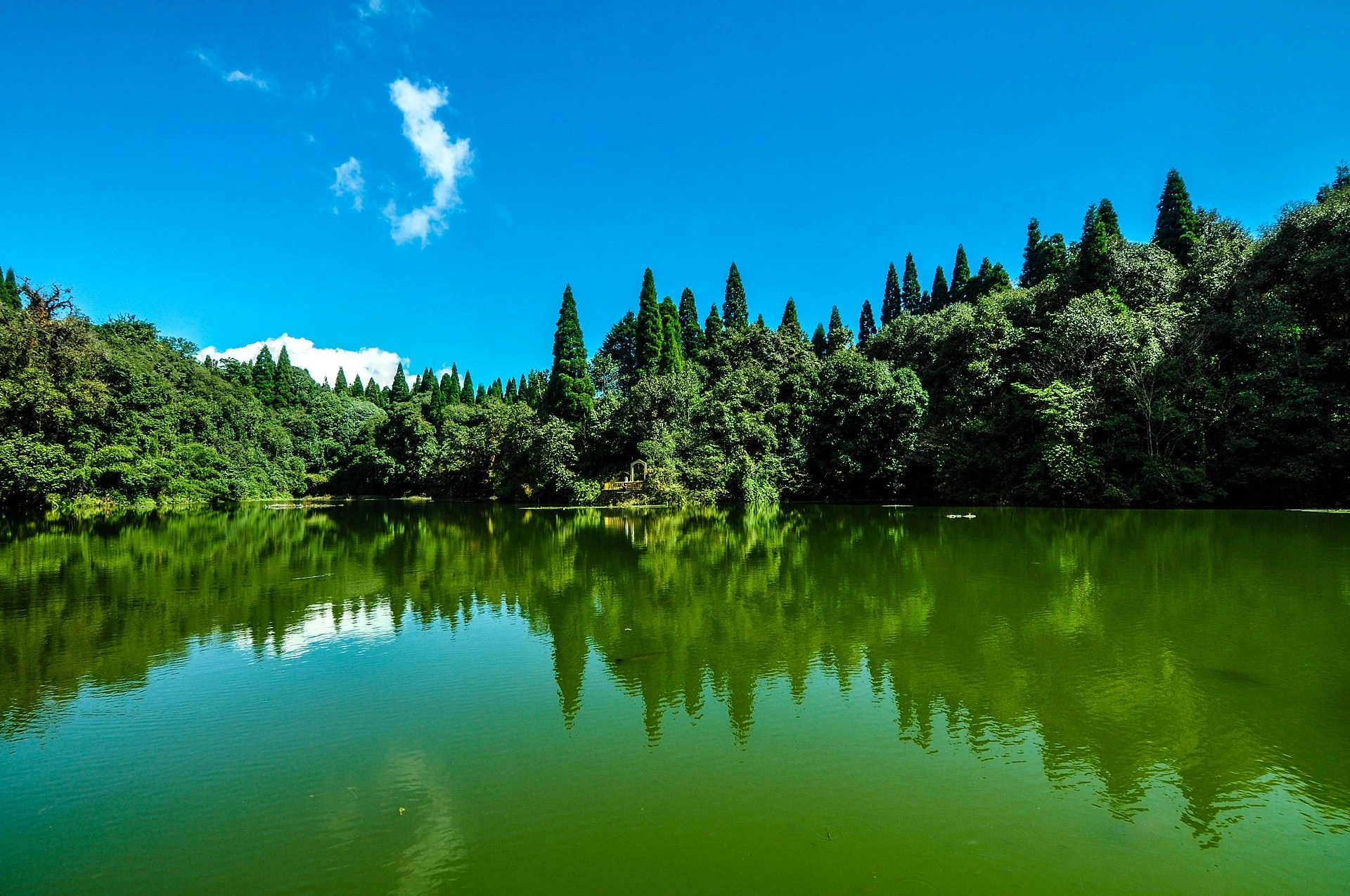
Mai Pokhari is a small lake about 22 km north of Ilam Bazaar, sitting at 2,100 metres. It has nine distinct corners, and each one is said to honour a different deity, which is why it is a pilgrimage site as much as a viewpoint.
It is also a wetland of international importance, listed under the Ramsar Convention in October 2008 as site number 1850.
Most people give it thirty minutes. It deserves more, and it needs more attention than it currently gets.
Quick answers
What is Mai Pokhari? A spring-fed lake and Ramsar-listed wetland in Ilam district, eastern Nepal, sacred to Hindus, Buddhists and the Kirat community.
Where is it? About 22 km north of Ilam Bazaar, roughly an hour by road on a rough climb.
How high is it? 2,100 metres, or 6,900 feet.
How big? The lake itself is around 12 hectares. The protected Ramsar area, including the surrounding watershed, covers 90 hectares.
Why nine corners? Each corner is associated with a deity. It is the reason the lake is a pilgrimage site.
How long do you need? Two hours if you walk the forest. Thirty minutes if you only want the lake.
What is Mai Pokhari?
A lake formed by the ground giving way.
Mai Pokhari sits in a hollow created by natural ground subsidence, filled by springs and rainfall rather than a river. That is unusual, and it is part of why the ecology here is distinctive. There is no inflow washing through it, so what lives in the water has been there a long time.
The shape is what people notice first. The lake has nine corners, and in local tradition each one honours a different deity. The lake itself is associated with the goddess Bhagawati.
That gives the place a religious status you feel as soon as you arrive. There are shrines at the water, and people come to worship rather than sightsee.
It is sacred across three traditions at once, to Hindus, to Buddhists, and to the Kirat community. That combination is not common, and it is worth knowing before you visit so you behave like you are somewhere that matters to people.
What does Ramsar status actually mean?
It means the wetland is recognised internationally as ecologically important, not that it is a national park.
The Ramsar Convention is a global treaty on wetland conservation. Nepal listed Mai Pokhari in October 2008 as site number 1850. Listing commits the country to managing the site wisely and reporting on its condition.
What it does not mean is heavy protection on the ground. There are no gates, no rangers checking tickets, and no restrictions on walking around. The status is a commitment on paper, and whether it translates into care is a separate question.
That distinction matters here, as the next section explains.
The problem nobody mentions
Mai Pokhari is in trouble, and the reasons are specific.
Goldfish. Ornamental goldfish were introduced to the lake and have established themselves. They compete with and prey on native species, and in a closed spring-fed system with no flushing, introduced fish do not simply wash away.
Japanese pine. Exotic pine has spread through the watershed above the lake. It changes the soil, crowds out native forest, and alters what the catchment feeds into the water.
The Ilam Municipality states this plainly, noting that both have adversely affected indigenous plants and animals, birds and amphibians especially.
There is more. Pesticide runoff from surrounding tea plantations, expanding cardamom cultivation, construction and settlement pressure all press on a 90 hectare site.
I am including this because a guide that only enthuses is not useful. If you go, you are visiting a place under real pressure, and knowing that changes how you treat it.
What lives there?
The wetland supports far more than its size suggests.
Around 300 bird species have been recorded in the area. Among the larger animals are leopard cat, Eurasian otter, and the white-rumped vulture, a species that has collapsed across South Asia and is now critically endangered.
The forest around the lake holds Schima and Castanopsis, laurel oak, and rhododendron. Epiphytic orchids grow on the trees, and water lilies sit on the lake itself.
For birdwatchers this is the most interesting single site in the district by a wide margin. Bring binoculars. Most visitors do not, and they see a pond.
How do you get to Mai Pokhari?
It is about 22 km north of Ilam Bazaar by road, and the drive takes roughly an hour in good conditions.
Treat that hour as a best case. The route north climbs through Barbote and is in worse condition than the highway running south to Kanyam. In monsoon, or after rain has worked on the surface, allow longer.
| From | Distance by road | Time |
|---|---|---|
| Ilam Bazaar | about 22 km | about 1 hr |
| Kanyam | about 56 km | about 2 hrs 35 min |
| Shree Antu | about 60 km | about 2 hrs 50 min |
Those last two rows are the ones worth noticing. Kanyam and Shree Antu sit close to Mai Pokhari on a map and are nowhere near it by road. Both are south and east of Ilam Bazaar, and Mai Pokhari is north of it, so getting between them means driving back through town and out the other side.
In practice that means Mai Pokhari does not combine with a tea garden day. Give it its own half day from Ilam Bazaar.
The direction matters. Kanyam and Shree Antu are both south and east of Ilam Bazaar, towards the plains and the Indian border. Mai Pokhari is the opposite way, north and uphill. You cannot chain it onto a Kanyam trip without backtracking through town.
Full detail on reaching the district is in the Ilam travel guide.
Can you stay near Mai Pokhari?
Yes. There are hotels a short way from the lake, so you do not have to treat this as a round trip from Ilam Bazaar.
That is worth knowing, because the drive back down the rough road in the dark is the least appealing part of the day. Staying up here also puts you at the water early, which is when the birds are active and the lake is quiet.
If you are birdwatching, stay. If you are passing through for an hour, the day trip is fine.
When is the best time to visit?
October to November gives the clearest weather and the most comfortable walking.
Spring, March through May, is better if you have come for birds or for the rhododendron in the surrounding forest.
| Season | Months | What to expect |
|---|---|---|
| Post-monsoon | Oct to Nov | Clear, cool, best all round |
| Spring | Mar to May | Rhododendron, active birdlife |
| Monsoon | Jun to Sep | Full lake, leeches, difficult roads |
| Winter | Dec to Feb | Cold at 2,100 m, quiet, often clear |
At 2,100 metres this is higher than Kanyam and cooler than Ilam Bazaar. Bring a layer whatever the month.
How does it compare to the tea gardens?
It is a different kind of visit entirely, and expecting a tea garden experience is why some people leave disappointed.
| Mai Pokhari | Kanyam | |
|---|---|---|
| Elevation | 2,100 m | about 1,676 m |
| Direction from Ilam | North, uphill | South, on the highway |
| Draw | Sacred lake, forest, birds | Walking in tea |
| Crowds | Quiet | Busy at weekends |
| Time needed | 1 to 2 hours | 2 to 3 hours |
If your trip is about tea, Kanyam and Shree Antu are the priorities. Mai Pokhari earns its place if you care about birds, forest, or the religious side of the district.
Common mistakes
Treating it as a photo stop. Thirty minutes at the water and back in the car misses the forest, which is the better half.
Expecting a big lake. It is a pond, not a Pokhara. The interest is ecological and religious, not scenic scale.
Forgetting it is a pilgrimage site. There are shrines here and people worshipping. Dress and behave accordingly.
Trying to combine it with Kanyam in one hop. They are in opposite directions from Ilam Bazaar.
Coming without binoculars. With 300 bird species recorded, this is the one place in Ilam where they change the visit.
Frequently asked questions
What is Mai Pokhari famous for?
Its nine corners, each honouring a deity, and its status as a Ramsar-listed wetland of international importance. It is a pilgrimage site for Hindus, Buddhists and the Kirat community, and a significant bird habitat.
Why does Mai Pokhari have nine corners?
Each of the nine corners is associated with a different deity in local tradition. That is what makes the lake sacred rather than simply scenic.
When was Mai Pokhari designated a Ramsar site?
In October 2008. It is Ramsar site number 1850.
How high is Mai Pokhari?
2,100 metres, or about 6,900 feet, above sea level.
How far is Mai Pokhari from Ilam Bazaar?
About 22 km north by road, roughly an hour in good conditions. It is the opposite direction from Kanyam and Shree Antu, and the road is rougher than the highway running south.
Is there a festival or mela at Mai Pokhari?
Devotees come through the year rather than on one fixed day, and no annual mela is recorded at the lake itself. Ilam district does have melas, including Mai Beni Mela on Maghe Sankranti and Gajurmukhi Mela on Kartik Purnima, but those are held elsewhere in the district.
Is Mai Beni the same as Mai Pokhari?
No. The names are close and they get confused. Mai Beni is a river confluence on the Mai Khola and hosts an annual mela on Maghe Sankranti. Mai Pokhari is the nine-cornered lake north of Ilam Bazaar.
Is Mai Pokhari worth visiting?
Yes if you care about birds, forest or the religious character of the district. If you only have a day in Ilam and want tea gardens, spend it at Kanyam instead.
Can you swim in Mai Pokhari?
No. It is a sacred lake and a protected wetland. Treat it as a place of worship, not a swimming spot.
Before you go
Mai Pokhari needs its own half day, and the 3 day Ilam itinerary shows where that fits. Mai Pokhari rewards slowness more than anywhere else in Ilam. Walk the forest, sit for a while, and take binoculars if you own a pair.
If something here has changed, particularly the road or the state of the lake, tell me and I will update it.