
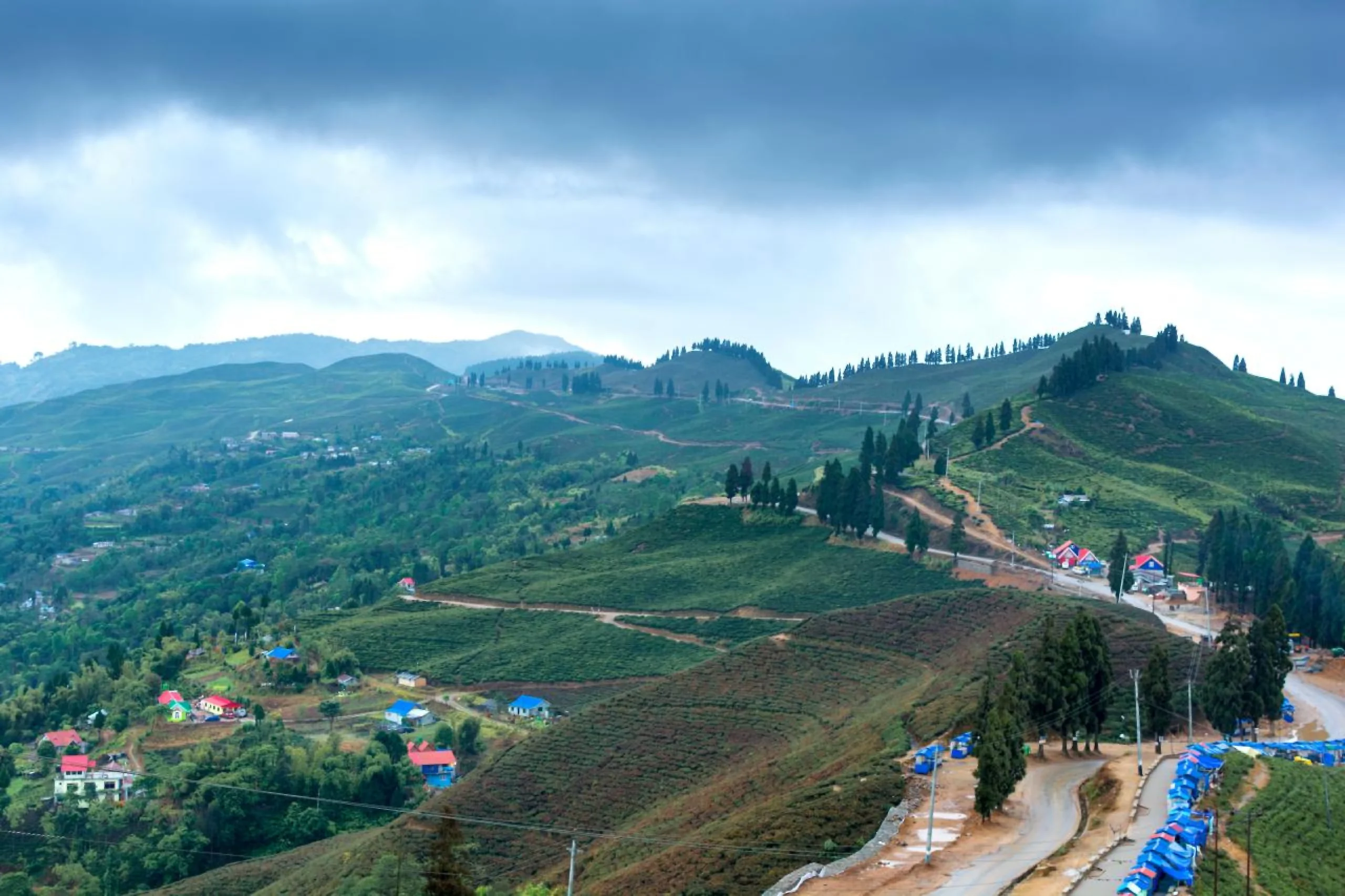
Kanyam is a tea garden village in Ilam district, eastern Nepal, and it is the image most people have in their head when they think of Nepali tea country. Wide green slopes, a road running through the middle, and tea in every direction.
It sits at about 1,676 metres, or 5,500 feet, in Suryodaya Municipality, the same municipality as Shree Antu. The estate covers roughly 216 hectares with about 200 hectares planted.
Quick answers
What is Kanyam known for? Orthodox tea, open tea garden slopes, and being the easiest place in Ilam to walk into a working tea estate.
Where is it? Suryodaya Municipality, Ilam district, Koshi Province, eastern Nepal, on the road between Bhadrapur and Ilam Bazaar.
How far from Ilam Bazaar? 30 to 45 minutes. NPR 200 to 300 in a local taxi, NPR 1,000 to 1,500 for a van.
Best time? October to November for clear air. March to May if you want to see plucking.
How long do you need? Two to three hours. It is a stop, not a destination.
Is it worth it? Yes, if you go early on a weekday. Less so at midday on a Saturday.
What is Kanyam known for?
Tea, and being easy to reach.
Kanyam produces orthodox tea. That is the leaf-style processing used across the border in Darjeeling, rather than the CTC method behind the strong milk tea most of Nepal drinks daily. It is why Ilam tea gets compared to Darjeeling so often. Same ridge system, same elevation band, similar processing.
The estate runs to about 216 hectares with roughly 200 hectares under tea, according to the Nepal Tea Development Corporation, which manages several of the country’s estates.
The second thing Kanyam is known for is being accessible. The highway between Bhadrapur and Ilam Bazaar runs straight through it. You do not need a guide or a plan. You get out of the taxi and you are standing in it.
That accessibility is the whole story of Kanyam, good and bad.
Is Kanyam worth visiting?
Yes, with a condition attached.
Go on a weekday morning and it is genuinely lovely. Mist on the slopes, women working the rows, and paths you can walk for an hour without meeting anyone. Go at midday on a Saturday or during Dashain and you are sharing a roadside with parked cars, picnic groups and music.
Kanyam is the most visited spot in Ilam by a wide margin, and it is domestic tourism rather than foreign. That is not a criticism. It just means the experience depends almost entirely on timing.
If you have one morning in Ilam and you want to walk in tea, come here early. If you want quiet above all else, the gardens around Shree Antu are steeper, emptier and harder to reach, which is exactly the point.
Where is Kanyam and how do you get there?
Kanyam sits on the main road between the plains and Ilam Bazaar, which makes it the easiest stop in the district.
There are two ways to do it, and the cheap one is cheap for a specific reason.
Local taxi, NPR 200 to 300. Taxis run the route between Ilam and Jhapa, meaning Birtamode, Damak and Itahari. Kanyam sits on that same road. So you are not hiring a car, you are getting a seat in one already making the trip. That is why it costs so little.
You can pick one up going Ilam to Kanyam, Kanyam back to Ilam, or Kanyam onward down to Jhapa. No booking needed.
Van, NPR 1,000 to 1,500. A vehicle to yourself rather than a shared seat. Worth the difference if you have luggage, a group, or you want to stop where you like along the way.
| Option | Time | Cost | Best for |
|---|---|---|---|
| Local taxi on the Ilam to Jhapa route | 30 to 45 min | NPR 200 to 300 | Saving money |
| Van | 30 to 45 min | NPR 1,000 to 1,500 | Comfort, groups, luggage |
Coming from Bhadrapur airport, you pass Kanyam on the way to Ilam Bazaar. It is about 48 km from the airport, roughly an hour and a half, and Ilam Bazaar is another hour beyond it. Stopping on the way in makes more sense than backtracking later.
Full detail on reaching the district is in the Ilam travel guide.
How high is Kanyam?
Kanyam sits at about 1,676 metres, which is 5,500 feet above sea level. That figure comes from the Nepal Tea Development Corporation, the state body that manages the estate.
That is higher than Ilam Bazaar at around 1,200 metres, and well below Antu Danda ridge at 2,328 metres. It puts Kanyam in the elevation band where orthodox tea does best, which is not a coincidence.
Practically, it means cool mornings and comfortable afternoons for most of the year. You will want a layer early and probably not by ten.
When is the best time to visit Kanyam?
October and November give the clearest air and the greenest slopes after the monsoon.
March to May is the other window, and it is the more interesting one if you care about tea rather than photographs. First flush plucking runs in spring, so the gardens have people working in them.
| Season | Months | What it is like |
|---|---|---|
| Post-monsoon | Oct to Nov | Clear, green, most comfortable |
| Spring | Mar to May | Plucking season, warmer, hazier |
| Monsoon | Jun to Sep | Deepest green, heavy rain, leeches |
| Winter | Dec to Feb | Cold, quiet, gardens dormant and duller |
Winter is the underrated one for crowds and the overrated one for scenery. The bushes go dormant and the colour flattens, but you will have the place close to yourself.
Avoid Nepali public holidays if you can. Dashain and Tihar turn Kanyam into a car park.
What is there to do?
Walk in the gardens
This is the main event and it is free. Paths run through the bushes from the roadside. You can wander for an hour or three without any arrangement.
Stay on the paths between sections rather than pushing through planted rows. These are working farms and the bushes are the crop.
Watch the plucking
In season, mostly spring through autumn, you will see women working the rows with baskets. It is worth watching for a while rather than photographing and moving on.
Ask before taking close photographs of people working. This is a job, not a display.
Buy tea
Kanyam has roadside stalls and shops. My advice in the Ilam guide still stands: the bazaar in Ilam has better selection and better knowledge behind the counter.
If you do buy here, ask for orthodox rather than whatever is nearest the till, and ask to taste. The Ilam tea guide covers what orthodox actually means and how to pick a good one.
Picnic
This is what most Nepali visitors come for, and it is the reason the place is busy at weekends. If you want to join in rather than avoid it, come Saturday and bring food.
Kanyam or Shree Antu?
They are about 15 km apart, which is 40 minutes by road, and they are not the same experience.
| Kanyam | Shree Antu | |
|---|---|---|
| Elevation | about 1,676 m | 2,328 m at the tower |
| Getting there | On the highway, easy | 40 min on from Kanyam, then a climb |
| Terrain | Wide, open, gentle | Steep hillside |
| Crowds | Busy, especially weekends | Quiet |
| Main draw | Walking in tea | Sunrise and Kanchenjunga |
| Time needed | 2 to 3 hours | An overnight stay |
Do both if you have three days. If you only have one day, Kanyam. If you only care about the view, Shree Antu and stay the night.
If you have a fourth day and care about birds or forest rather than tea, Mai Pokhari is north of Ilam Bazaar and a completely different kind of visit.
Common mistakes
Arriving at midday on a weekend. The single biggest factor in whether you enjoy Kanyam. Come before nine.
Treating it as the whole trip. Kanyam is two or three hours. Building a day around it leaves you standing on a roadside.
Walking into the planted rows. It is a farm. Use the paths.
Buying the first tea you see. Roadside stalls near the highway are priced for people who are not going to compare.
Frequently asked questions
Is Ilam Kanyam worth visiting?
Yes, if you time it. On a weekday morning it is one of the most pleasant places in eastern Nepal to walk. At midday on a weekend it is crowded and noisy. The timing matters more than anything else.
What is the best time to visit Ilam Kanyam?
October to November for the clearest weather. March to May if you want to see plucking. Avoid Dashain and Tihar unless you enjoy crowds.
How far is Kanyam from Ilam Bazaar?
Thirty to forty five minutes. A local taxi on the Ilam to Jhapa route costs NPR 200 to 300, because Kanyam is on that road and you are sharing a vehicle already going that way. A van to yourself runs NPR 1,000 to 1,500.
Is Kanyam tea the same as Darjeeling tea?
Not the same, but closely related. Both come from the same ridge system at similar elevations and both use orthodox processing, which is why they are so often compared.
Can you visit the tea factory?
Yes. There is a tea processing factory at Kanyam and it is open to visitors.
Before you go
Kanyam works best as a stop on the way up from Bhadrapur, which is how the 3 day Ilam itinerary uses it. Kanyam is the easiest thing to do in Ilam and the easiest to do badly. Come early, walk further than the roadside, and give it two hours rather than twenty minutes.
If a fare or a detail here has changed, tell me and I will update it.