
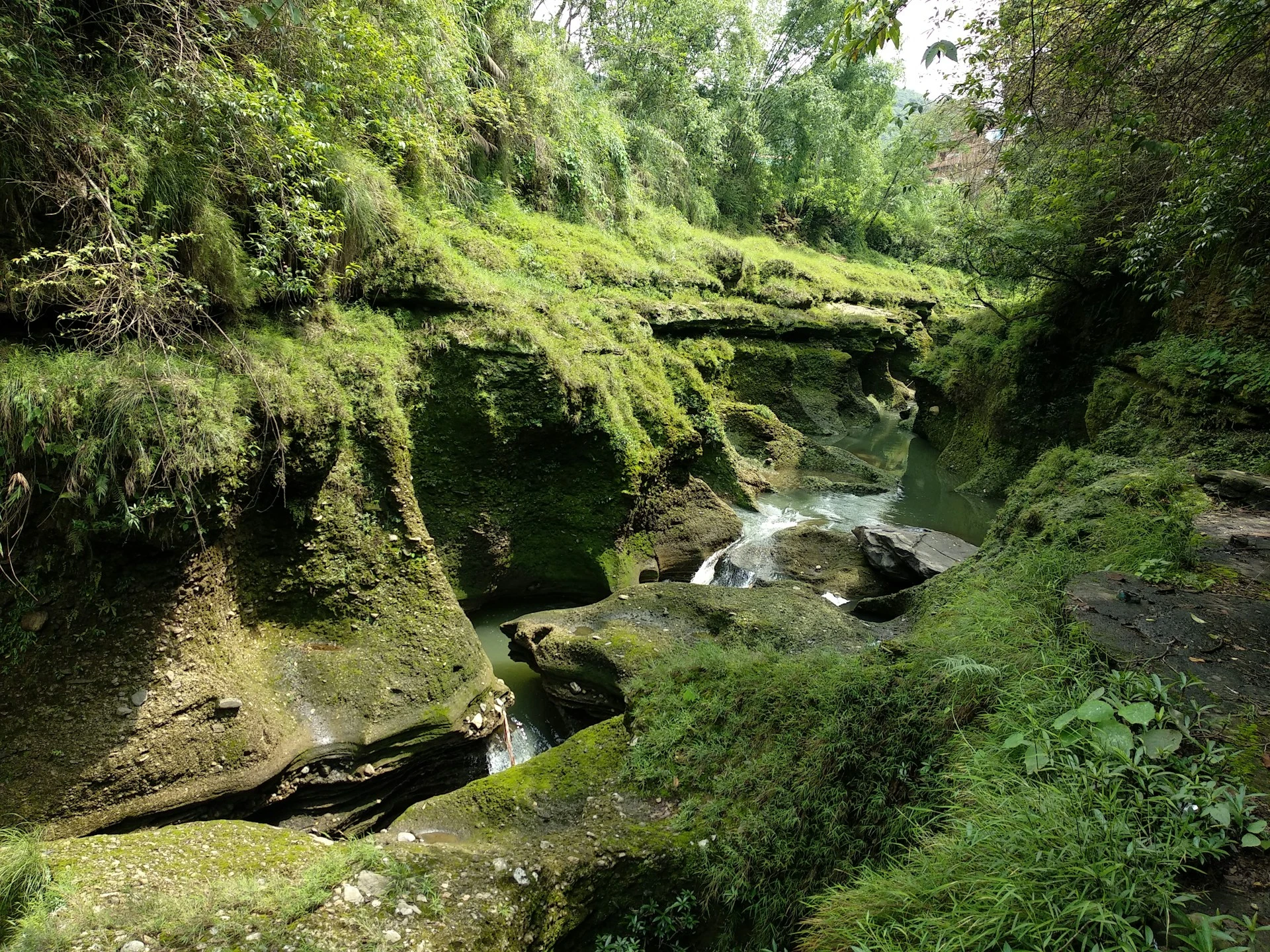
Davis Falls is a waterfall in the south of Pokhara that does something unusual: it drops into a sinkhole and disappears. The water runs on underground rather than continuing as a river, which is why the Nepali name is Patale Chhango, roughly “underworld waterfall”.
Gupteshwor Mahadev Cave sits directly across the road, and the same water passes through it. Nobody visits one without the other, so treat them as a single stop.
Set your expectations before you go. This is a ticketed roadside site in a city, not a wilderness waterfall, and how impressive it looks depends entirely on when you turn up.
Why the water varies so much
Here is the thing most guides leave out. Davis Falls is fed by the Phewa Lake dam, not by a free-running mountain river.
That matters practically. The volume coming over depends on how much water is being let out of the dam, which in turn depends on the season and on what the dam is doing that week. In monsoon and just after, it is loud and full. In the dry months it can be a trickle over the rocks with a queue of people photographing it anyway.
So if you are told the waterfall was underwhelming, that is not a matter of taste. It is a matter of timing. Autumn, straight after the monsoon, gives you the best odds of water and clear weather at once.
The tunnel the water disappears into runs roughly 150 metres and sits about 30 metres below ground level. It comes out through the cave opposite.
Nobody agrees what it is called
You will see it written as Davis Falls, Devi’s Fall, Davi’s Fall and David’s Fall, sometimes on signs a few metres apart. Nepal Tourism Board writes it “Davi’s Fall”. Locals call it Patale Chhango.
The reason is a death. On 31 July 1961, a Swiss couple were swimming when water was released and the overflow swept the woman into the pit. Her body was recovered three days later, downstream in the Phusre River. The falls were named after her, and the spelling has been drifting ever since through Nepali pronunciation and back into English.
Accounts differ on the details, including her name and exactly who asked for the naming, and I am not going to pretend one version is settled when the sources plainly disagree. What is consistent across all of them is the year, the drowning, and that the name is a memorial rather than a description.
It is worth knowing while you stand at the railing. The sinkhole you are photographing killed someone, and the barriers exist for a reason.
Gupteshwor Mahadev Cave, across the road
The cave is a Hindu shrine and a genuine cave system, entered down a long flight of steps from a gate on the opposite side of the road. Inside there is a Shiva shrine, and further in you reach the point where the water from Davis Falls comes through.
Its length is disputed, and the gap is large. The cave’s own official site calls it 2,950 metres and “probably the longest and most attractive cave in South Asia”. The surveyed figure recorded from British caving expeditions to the Himalaya is 2,057 metres. Both numbers are in circulation and get repeated as fact.
You will not walk anything like either distance. The section open to visitors is a short developed stretch with steps and lighting, not a caving expedition.
The cave is open 7am to 6pm according to its official site. It is a working temple as well as a tourist site, so people are there to worship, not only to look.
Bats live in it, and a British expedition catalogued the cave fauna back in 1976, which tells you the place has been of scientific interest far longer than it has been a ticketed attraction.
How long to give it
Half an hour at the falls, another half hour or so in the cave. It is a stop, not an afternoon.
The two sit in Chhorepatan in the south of the city, well away from Lakeside, so the travel time is longer than the visit. That is the honest arithmetic, and it is the reason I would not make a special trip out here on its own.
Where it makes sense is as part of a day that takes in several places at once. I saw both on a full day taxi charter that covered the sights across the valley, which is the efficient way to do it. That day is set out in the Pokhara itinerary.
Worth knowing before you go
- Go after the monsoon if the waterfall itself matters to you. Autumn has both water and clear air.
- They are one stop, not two. Same road, opposite sides, one visit.
- Both gates charge, and the rate differs for Nepali and foreign visitors, the way it does at most paid sites in Nepal. I did not keep my tickets, so ask at the counter rather than budgeting from a figure you found online.
- The cave has a lot of steps. It goes down, and you come back up the same way.
- It is a temple as well as a sight. Dress and behave accordingly inside the cave.
- Photography at the falls is from behind railings, which is a limitation people find frustrating and a sensible one given the history.
The honest summary
Davis Falls is a fifteen to thirty minute stop that a lot of people arrive at expecting something bigger. The cave opposite is the more interesting half of the pair, and the two together make a reasonable hour if you are passing.
Go in the right season, treat it as one item on a longer day, and it earns its place. Build a morning around it and you will be disappointed.
The wider list of what is and is not worth your time in the valley is in things to do in Pokhara. The lake whose dam feeds this waterfall is covered in Phewa Lake.
Ticket prices change and I would rather this page were right than tidy. If yours differed, tell me.