
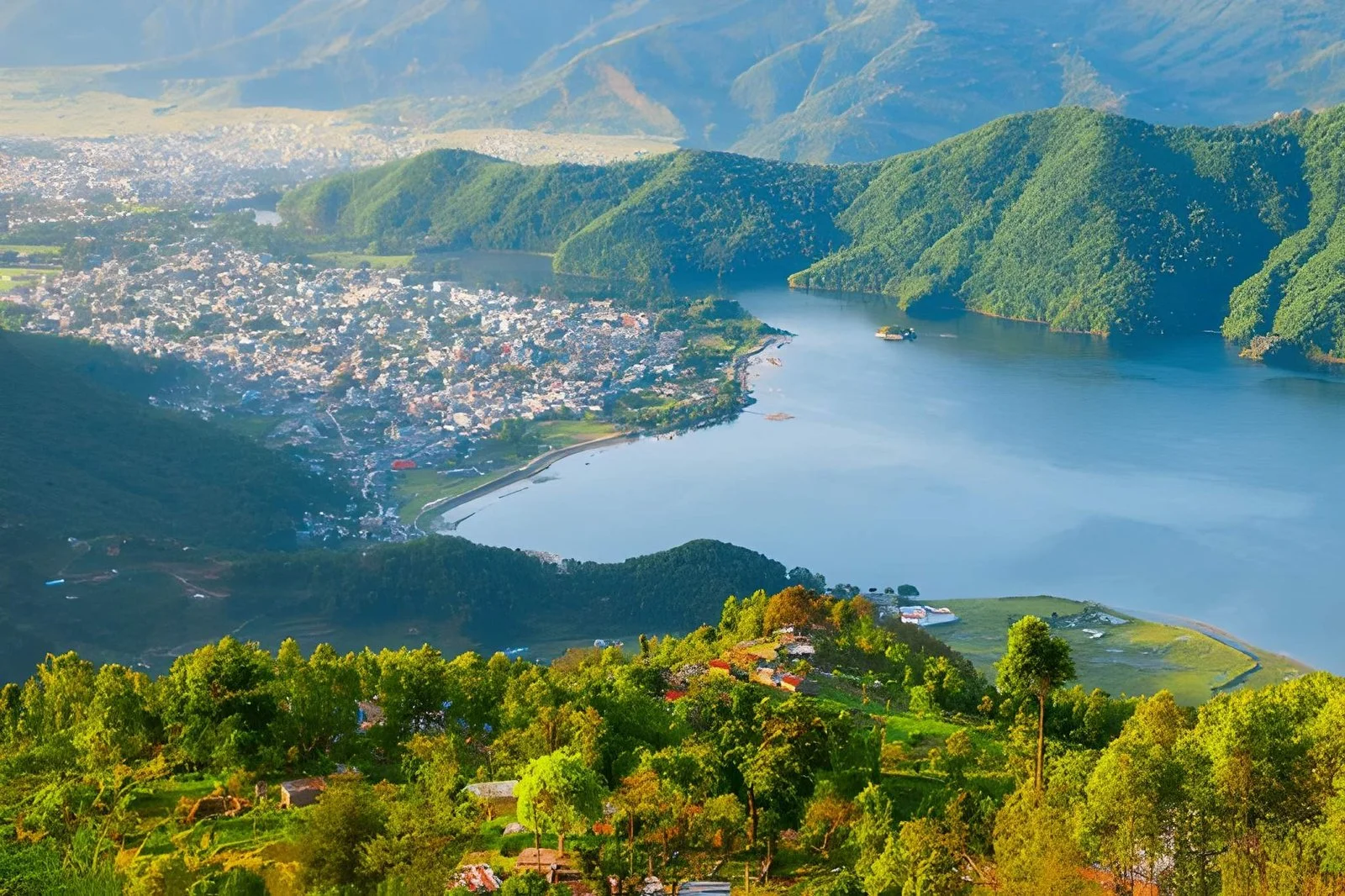
Pokhara sits at about 822 metres in Kaski district, roughly 200 km west of Kathmandu, and it is the second largest city in Nepal. What makes it worth the trip is the geography. The Annapurna range rises straight out of the valley floor, so you get 8,000 metre country from a lakeside cafe at subtropical altitude.
Pokhara is where I go on holiday, and I go back often. I was last there in May 2026. That is enough time in the valley to have a clear view of which things to do in Pokhara earn their reputation, and which are a photograph you have already seen.
Quick answers
Where is Pokhara? Gandaki Province, central Nepal, about 200 km west of Kathmandu.
What is it known for? Phewa Lake, mountain views of the Annapurna range, and being the starting point for most treks in the region.
Do you need a permit? Not for Pokhara itself. Treks into the Annapurna Conservation Area need permits, but the city and the lakes do not.
Is it walkable? Lakeside is. The rest of the city is not, and the sights are spread across the valley.
Best months? October and November for clear mountain views. March to May is the second window.
Why go to Pokhara?
Pokhara is where you go to see big mountains without walking to them.
That is the honest summary. In most of Nepal, serious Himalayan views cost you days on foot. In Pokhara you land, take a taxi to Lakeside, and Machhapuchhre is sitting at the end of the street. The valley floor is warm and low, the peaks behind it are enormous, and the gap between those two facts is the whole appeal.
Machhapuchhre is the one everyone photographs. It stands at 6,993 metres, and its name means “fishtail” in Nepali, after the twin summit you can see from the valley. Nobody has officially stood on top of it. A British team got within about 46 metres of the summit in 1957 and stopped there, because King Mahendra had granted permission on the condition that they not step on the summit itself. It is sacred to the Gurung people and to Shiva, and Nepal has issued no climbing permits since.
That story tells you something about the place. The mountain everyone comes to look at is one nobody is allowed to climb.
Being clear about what Pokhara is not: it is a city, not a village. It has traffic, concrete, and a tourist strip that sells the same trekking gear in forty shops. If you want quiet hills with almost no other visitors, that is a different trip.
What is actually worth doing in Pokhara?
The valley has more sights than most people have time for, and they are not equal. Here is how they sort out.
| Place | What it is | Time needed |
|---|---|---|
| Phewa Lake | The main lake, 4.4 km², boats and lakeside | Half a day or more |
| Sarangkot | Ridge viewpoint above the valley, sunrise spot | Half a day |
| World Peace Pagoda | White stupa on the ridge across the lake | 2 to 3 hours |
| Davis Falls | Waterfall that drains into an underground channel | 15 to 30 min |
| Gupteshwor Cave | Cave across the road from Davis Falls | 30 to 45 min |
| Begnas Lake | The quieter lake, east of the city | Half a day |
| Intl. Mountain Museum | Museum on Himalayan climbing and peoples | 2 hours |
| Pumdikot | Hilltop Shiva statue, newer viewpoint | 2 to 3 hours |
| Mahendra Cave | Limestone cave north of the city | 30 min |
| Bindhyabasini Temple | Hilltop temple in the old town | 30 to 45 min |
Those durations are how long the place holds your attention, not how long the round trip takes. Add travel on top, because the valley is bigger than it looks on a map.
Phewa Lake
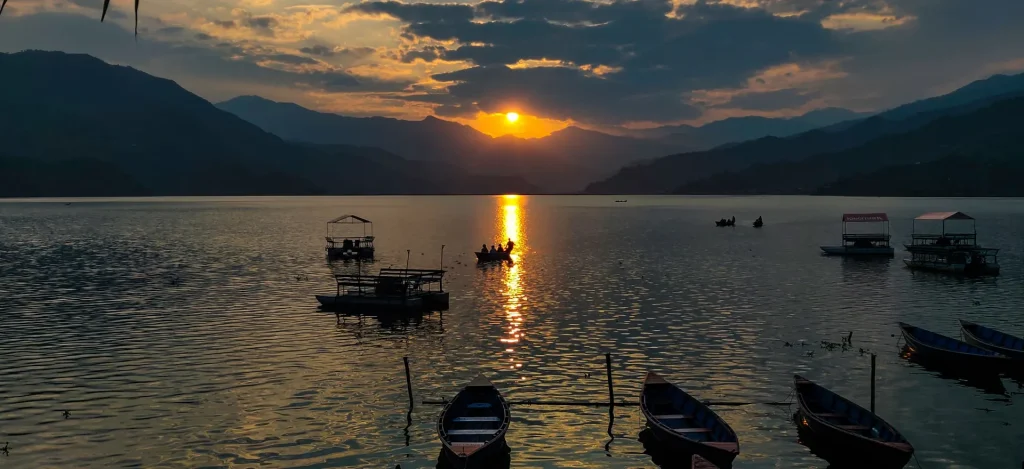
A dramatic golden hour sunset over Phewa Lake, Pokhara.
Phewa is the reason Lakeside exists. It covers 4.4 square kilometres, and it is the second largest lake in Nepal.
The thing worth understanding about Phewa is that it is not a wilderness lake. The eastern shore is the tourist strip: hotels, restaurants, boat hire, and a paved promenade. The southern and western shores are quiet, forested, and barely developed. Which Phewa you experience depends entirely on which way you point the boat.
Tal Barahi Temple sits on a small island near the eastern shore, and it is the standard short boat trip. On a still morning the mountains reflect in the water, and that reflection is the photograph you have seen on every Nepal tourism poster. On a hazy afternoon you will see none of it. This is a morning lake.
Sarangkot
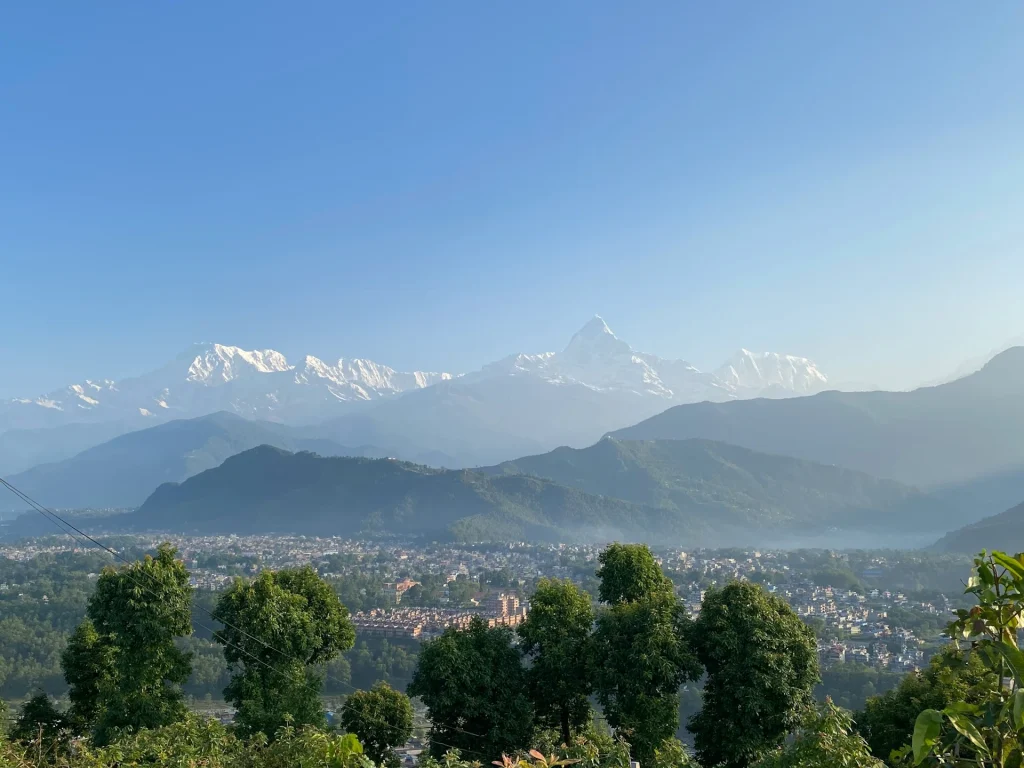
Pokhara valley and the Annapurna range viewed from Sarangkot.
Sarangkot is the ridge northwest of the lake, and it is the standard sunrise trip in Pokhara. You go up before dawn, watch the light hit Annapurna and Machhapuchhre, then come back down for breakfast.
It works, and it is also the single most crowded thing in the valley at sunrise. Everyone in Lakeside is sold the same trip, and they all arrive within twenty minutes of each other. If the idea of watching a sunrise alongside two hundred other people bothers you, this is worth knowing before you book.
Sarangkot is also where paragliding launches. The tandem flights that Pokhara is known for take off from this ridge and land near the lake.
The World Peace Pagoda
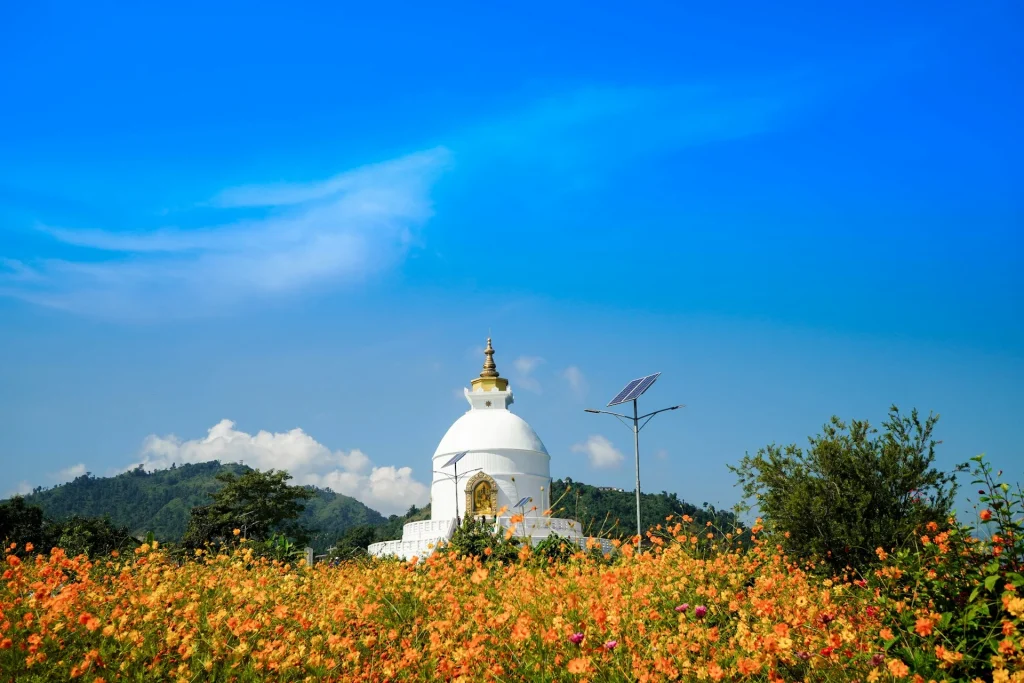
The pagoda is a white stupa on the Ananda Hill ridge on the far side of Phewa, and the view from it is the best cheap thing in Pokhara. You look down over the whole lake with the Annapurnas behind it, which is the one angle that gets both the water and the mountains in a single frame.
You can get there three ways: boat across the lake and walk up, drive around, or walk the whole way. The boat and walk combination is the one most people enjoy, and it turns a viewpoint into a half day rather than a photo stop.
Davis Falls and Gupteshwor Cave
These two sit directly across the road from each other in the south of the city, so nobody visits one without the other. Locally the waterfall is called Patale Chhango, which means something close to “underworld waterfall”, and the name is the point: the water drops into a sinkhole and disappears into an underground channel rather than continuing as a river.
Gupteshwor Mahadev Cave, opposite, is a cave shrine that runs down to the same underground watercourse.
This is the pairing where expectations need managing most. It is a roadside stop with a ticket gate, not a wilderness waterfall, and how impressive the water is depends heavily on the season.
Begnas Lake
Begnas is the alternative to Phewa, east of the city, and it is much quieter. There is no equivalent of Lakeside on it. If Phewa feels too developed, this is where to go instead.
Both lakes are part of something bigger. The Lake Cluster of Pokhara Valley was designated Nepal’s tenth Ramsar site on 2 February 2016, covering about 261 km² including the catchment. Ramsar listing is the international designation for wetlands of recognised ecological importance. The cluster takes in nine bodies of water: Phewa, Begnas, Rupa, Khaste, Dipang, Maidi, Gunde, Neurani and Kamalpokhari, plus the Seti catchment.
Most visitors see two of those nine and have no idea the other seven exist.
Pumdikot
Pumdikot is the newest of the viewpoints, a hilltop south of the lake with a large Shiva statue and a view back over the valley. It is not in older guidebooks, which is exactly why it is less crowded than Sarangkot at the moment.
The International Mountain Museum
The museum covers Himalayan mountaineering history and the peoples of the mountain regions. It is the right call on a day when the cloud is down and the viewpoints are pointless, which happens more often than the brochures suggest.
When is the best time to visit Pokhara?
October and November are the best months. The monsoon has cleared, the air is washed clean, and the mountain views are at their most reliable.
| Season | Months | What to expect |
|---|---|---|
| Autumn | Oct to Nov | Clearest mountain views, busiest season |
| Winter | Dec to Feb | Cold mornings, often very clear, fewer people |
| Spring | Mar to May | Warm, rhododendrons in the hills, increasing haze |
| Monsoon | Jun to Sep | Heavy rain, green valley, mountains often invisible for days |
The thing to understand about Pokhara is that the mountains are conditional. The city is at 822 metres and the peaks are above 6,000, so haze and cloud sit between you and the view for large parts of the year. People book Pokhara for the Annapurna panorama, arrive in late spring, and see nothing but white sky for three days.
If mountain views are the reason you are going, go in autumn or winter and give yourself more than one morning.
Where should you stay?
Lakeside is the default, and for a first visit it is the right answer. It runs along the eastern shore of Phewa, and nearly all the hotels, restaurants and trekking outfitters are on it or just off it. You can walk to the lake, walk to dinner, and get a taxi to anywhere else in the valley.
The trade off is that Lakeside is the most touristed strip in Nepal outside Thamel in Kathmandu. Damside, to the south, is quieter. Staying out near Begnas puts you in a completely different, much slower version of the same valley, at the cost of needing a vehicle for everything.
What does Pokhara cost?
Here is what I actually paid in May 2026, rather than a range gathered from booking sites.
| What | What I paid, May 2026 |
|---|---|
| Bus, Kathmandu to Pokhara | NPR 900 per person |
| Taxi, Prithvi Chowk bus park to Lakeside | NPR 300 |
| Hotel room on Lakeside | NPR 1,500 per night |
| Taxi charter, full day around the valley | NPR 6,000 for the car |
| Boat on Phewa Lake | from NPR 250 per boat, holds four |
The taxi charter is the one worth knowing about. The sights are scattered across the valley in four directions, and paying for individual rides eats the day in waiting. I booked a taxi on inDrive at 4am and asked the driver whether he did a full day package covering everything. He said yes, and that every taxi does. NPR 6,000 for the car, so it is cheap split between three or four and expensive on your own.
Two caveats on that number. It was close to off season, and the price is set by the driver rather than a rate card, so ask more than one. Nobody will offer this to you unprompted.
Pokhara is more expensive than Kathmandu, which surprises people. Most of that is ordinary tourist-town pricing and I do not think it is unreasonable. Budget more than you would for the same number of days in the capital.
Common mistakes
Treating Pokhara as a rest day. Most itineraries drop it in as two nights between Kathmandu and a trek. The valley has a week in it if you want one.
Booking mountain views in the wrong season. Arriving in June and expecting the Annapurna panorama is the most common disappointment here.
Doing everything in the afternoon. Haze builds through the day in most seasons. Viewpoints and the lake are morning activities. Museums and caves are the afternoon.
Underestimating distances in the valley. Sarangkot, Begnas, Davis Falls and Pumdikot are in four different directions. You can do them all in a single day if you charter a taxi, and I have, but you will spend a lot of that day in the car.
Frequently asked questions
How many days do you need in Pokhara?
Three full days covers the lake, one viewpoint for sunrise, the Peace Pagoda and the Davis Falls area without rushing. Two days is enough if you skip one. A week is not too long if you also want day walks in the hills around the valley.
Can you see the Annapurnas from Pokhara city?
Yes, on a clear day, from the lakeside and from many rooftops. Machhapuchhre and Annapurna South are the two most visible. Cloud and haze block them for long stretches, particularly from late spring through the monsoon.
Is Pokhara worth visiting without trekking?
Yes. The lakes, viewpoints, paragliding and the museum fill several days on their own, and Pokhara is the one place in Nepal where you get serious Himalayan views without walking for days.
What is Davis Falls?
Davis Falls, known locally as Patale Chhango, is a waterfall in southern Pokhara where the water drops into a sinkhole and continues underground instead of running on as a surface river. Gupteshwor Mahadev Cave sits directly opposite it.
Is Phewa Lake safe for boating?
Boating is standard and widely available. Take the life jacket, and be aware that afternoon wind picks up on the lake, which is another reason mornings are better.
Can you climb Machhapuchhre?
No. Nepal has issued no climbing permits for Machhapuchhre since the 1957 British attempt, which stopped short of the summit by agreement. The peak is sacred and remains officially unclimbed.
Which is better, Phewa or Begnas?
Phewa is more convenient and far more developed. Begnas is quieter and feels more rural. If you have one day, Phewa. If you have three, spend one of them at Begnas.
Can you see Mount Everest from Pokhara?
No. Everest sits roughly 200 km east of Pokhara in a different section of the Himalaya, and it is not visible from the city or from Sarangkot. What you actually see is the Annapurna massif, Dhaulagiri, Manaslu and Machhapuchhre. If someone points out an Everest silhouette from Sarangkot, they are misidentifying a nearer peak.
How many lakes are in Pokhara?
Nine. The Lake Cluster of Pokhara Valley has been a Ramsar site since 2 February 2016 and takes in Phewa, Begnas, Rupa, Khaste, Dipang, Maidi, Gunde, Neurani and Kamalpokhari, along with the Seti catchment. Most visitors see only Phewa and Begnas. The other seven sit east of the city and get very little tourist traffic.
Does it snow in Pokhara?
No. Pokhara sits at about 822 metres in a subtropical zone, so snow does not fall in the city itself. Winter mornings get cold and the valley often fills with fog, but the snow you see in photographs is on the peaks well above the valley, not in Pokhara.
Before you go
Pokhara rewards mornings and punishes afternoons. Almost every mistake people make here comes down to timing: wrong season, wrong hour of the day, or too little margin for the cloud to clear.
If you want the opposite of Pokhara, quiet tea hills with almost no other visitors, that is what Ilam is, at the other end of the country.
If you have been recently and something here has changed, particularly a fare or an opening time, tell me and I will fix it. More about who writes this and why on the about page.